
Short and often
Twenty minutes a day beats three hours on a Sunday. The spacing schedule assumes you keep coming back, and the streak is there to make that easy rather than to punish you.
Learn with us
Tanuki Sensei is a Japanese learning platform containing different learning paths, each designed for different skills and formal milestones. You start with the kanas, move to some fundamentals, and then start choosing your paths according to your preference and goals. The main paths include the JLPT levels, the EJU and the BJT. This page walks through the whole thing.
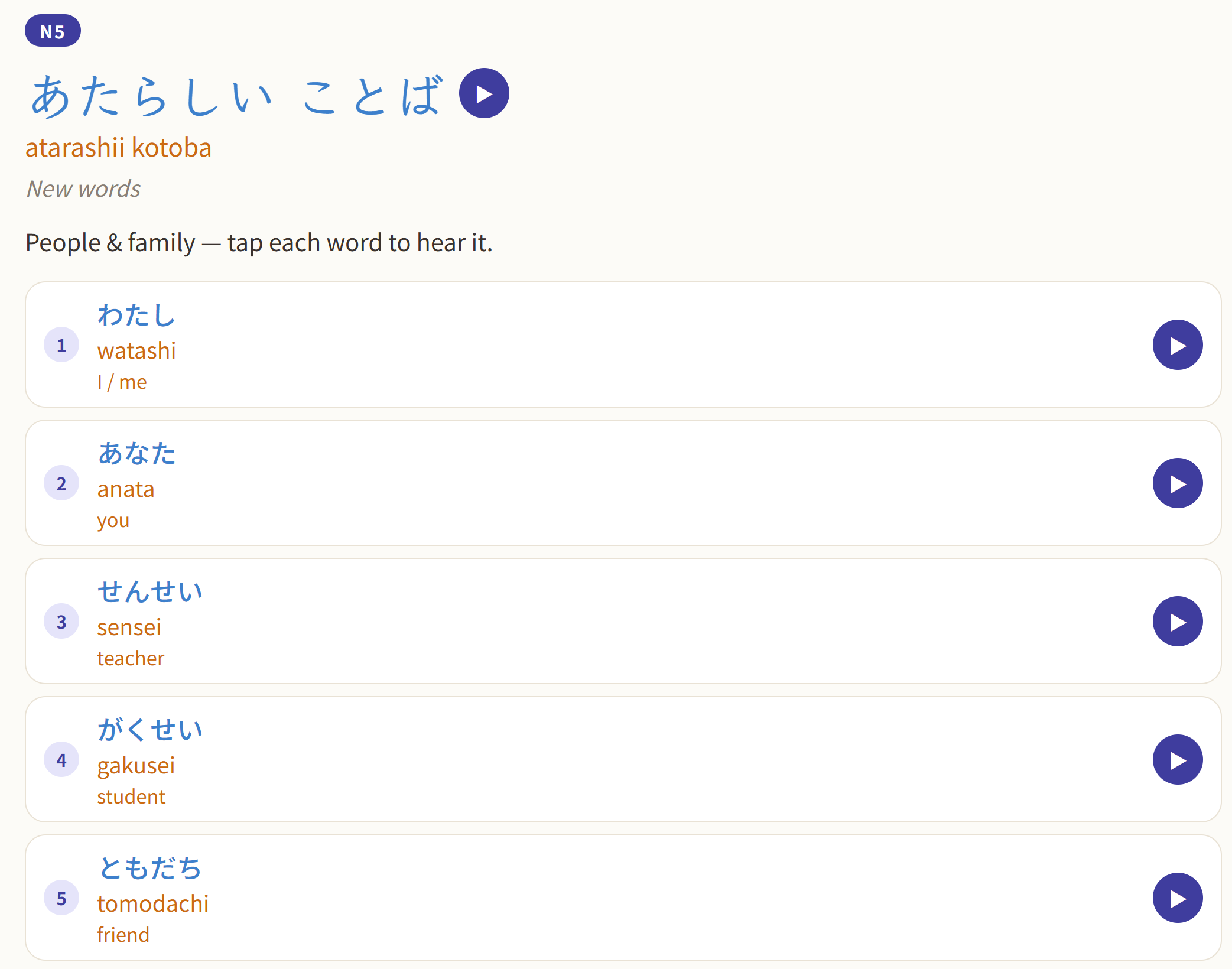
Every path is made of chapters, and a chapter contains three parts — learning, practice and test. The learning section is made of slides that teach you both new vocabulary and grammar rules. Then in the practice section you will be doing all sorts of exercises to get it all in, until you are ready to move on to the test, where you prove you have got it all and you are ready for what comes next.
The method
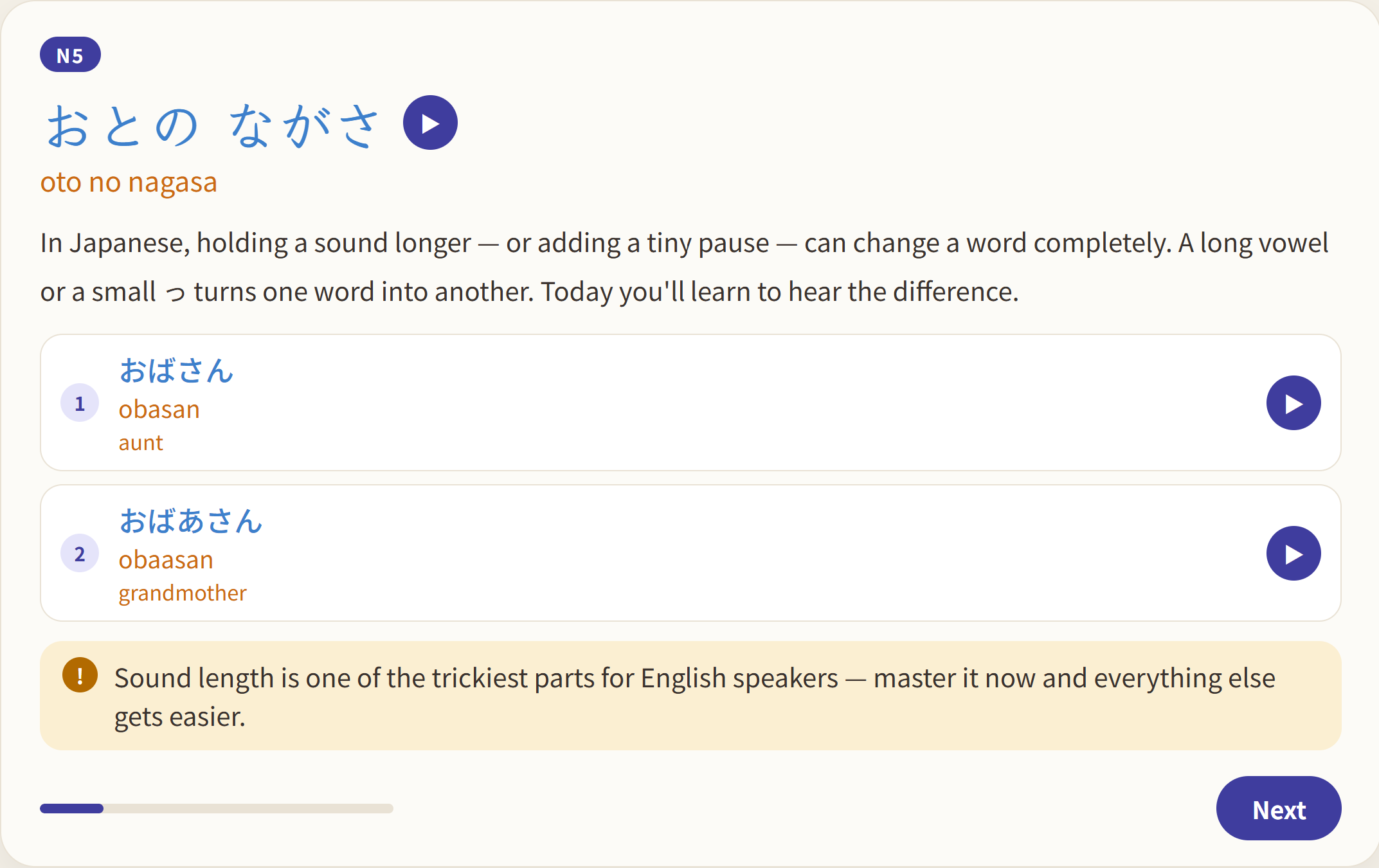
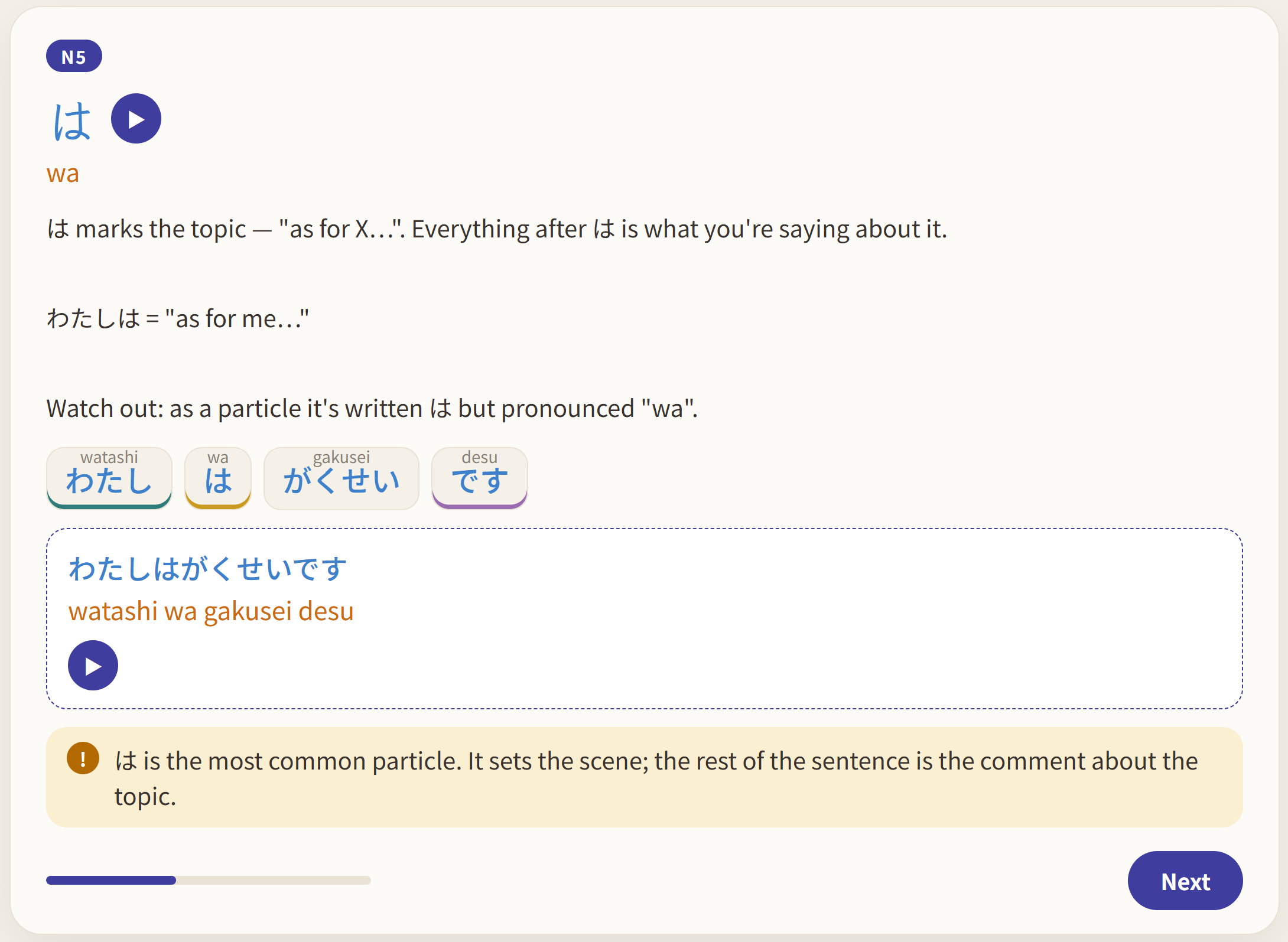
A lesson shows you real Japanese and then takes it apart. Every word carries its reading, so you are never guessing at pronunciation, and the parts of the sentence are colour-coded by the job they do — topic, object, verb, particle. The explanation is in your language; the Japanese stays Japanese.
Every sentence and every vocabulary item has audio. You can hear any of it, as often as you want, at the moment you meet it.
Exercises
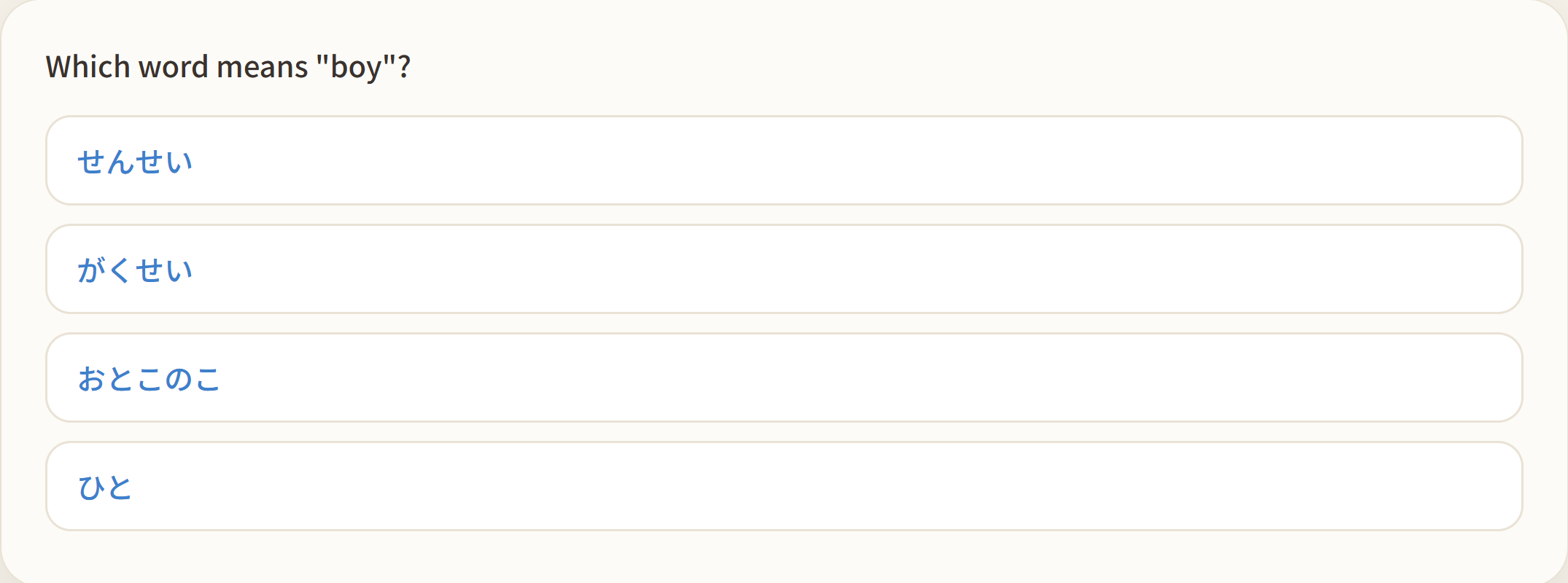
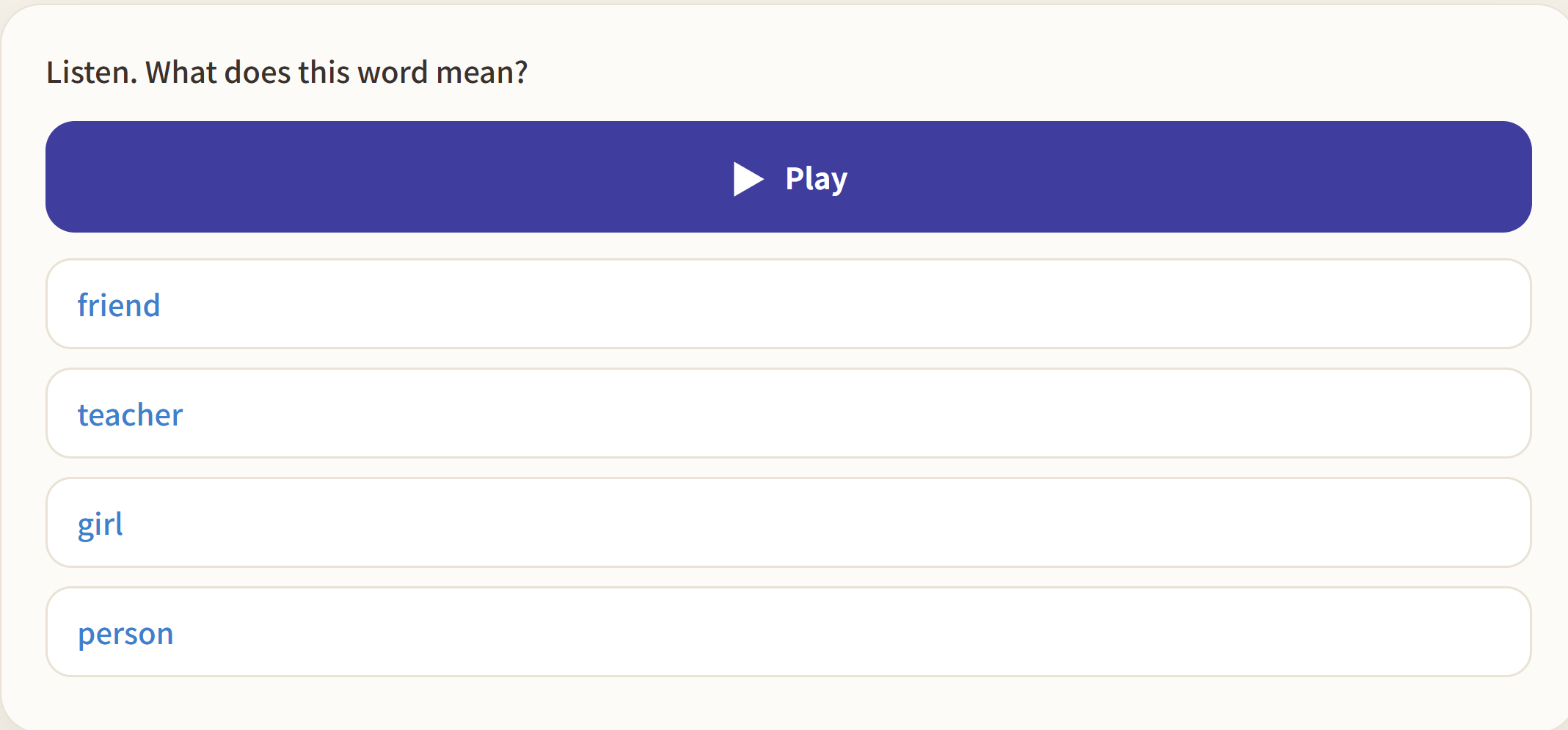
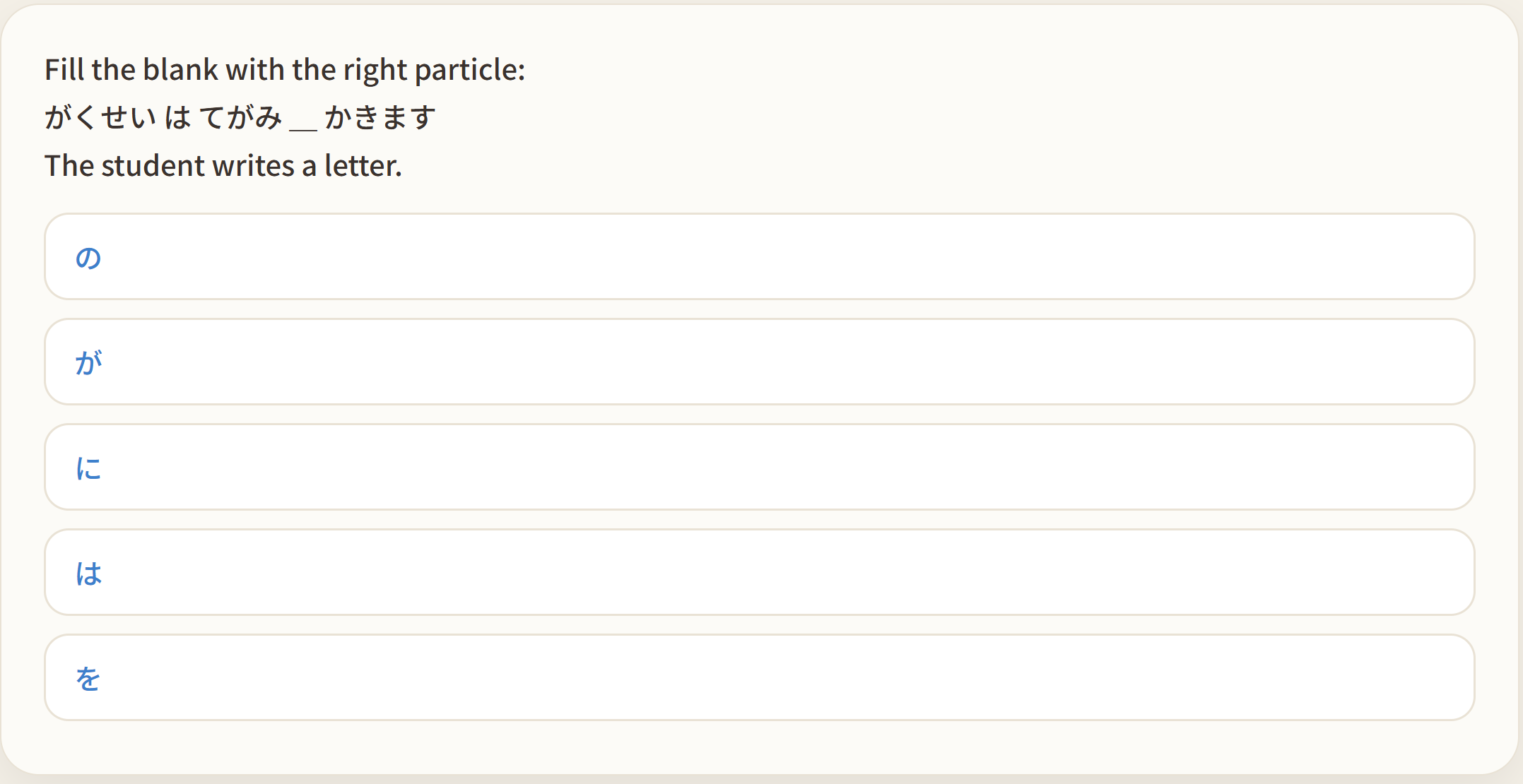
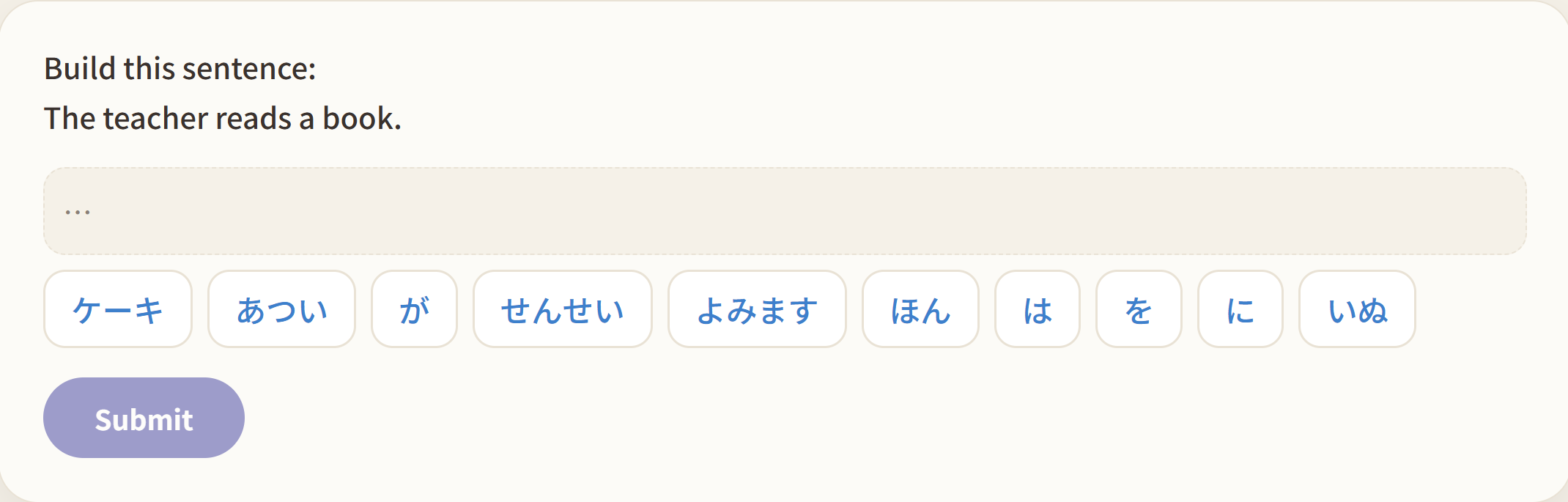
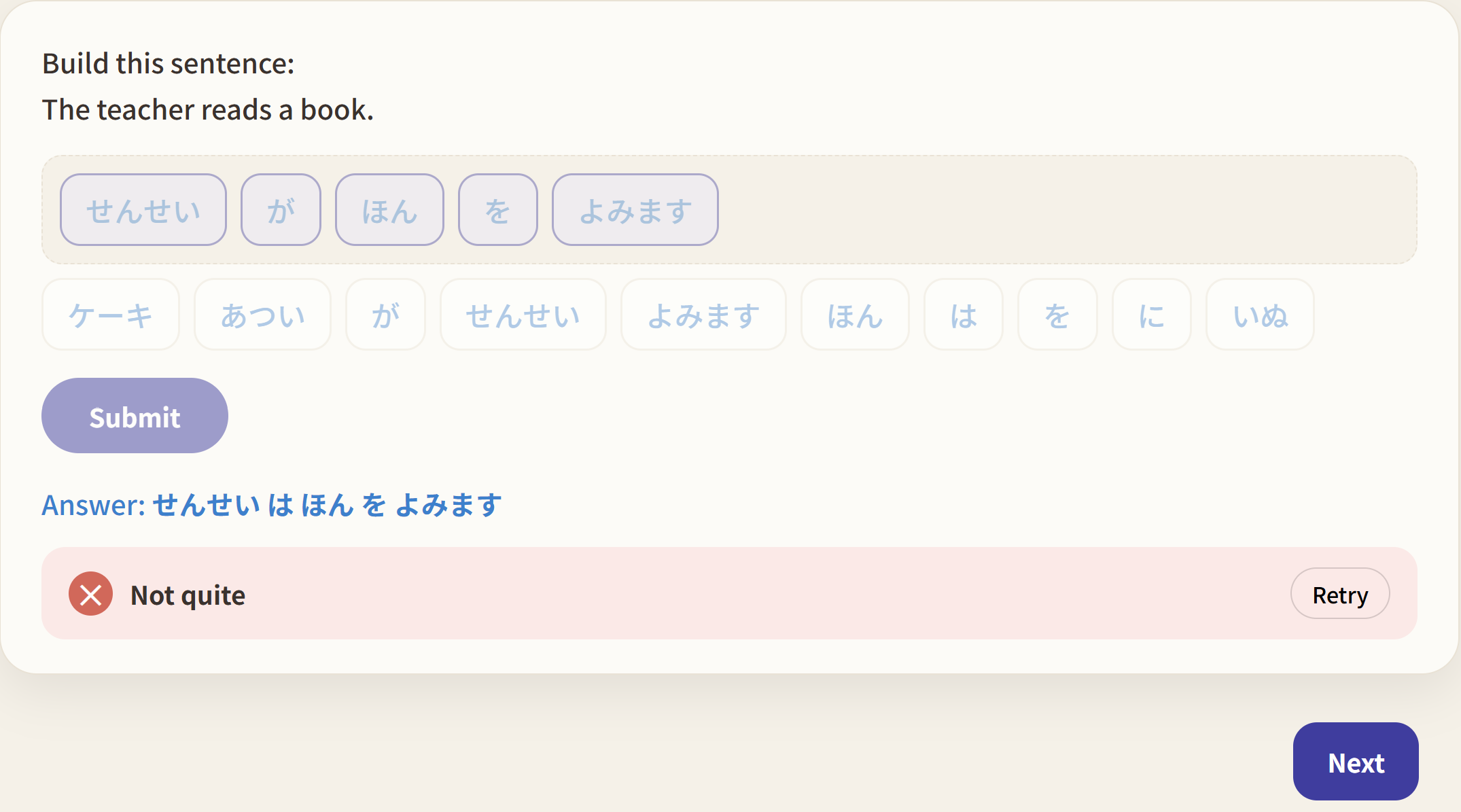
There is nothing to skim. What you have just read comes straight back as a question, in whichever form suits it — listening, meaning, particles, or building the sentence yourself.
Review
Every mistake goes into your mistake bank. Review sessions bring those items back on a spacing schedule — soon at first, then further apart as they stick. You are not re-reading things you already know; you are drilling the ones you do not.
This is the part that turns a chapter you finished into Japanese you actually retain.
Your notebook
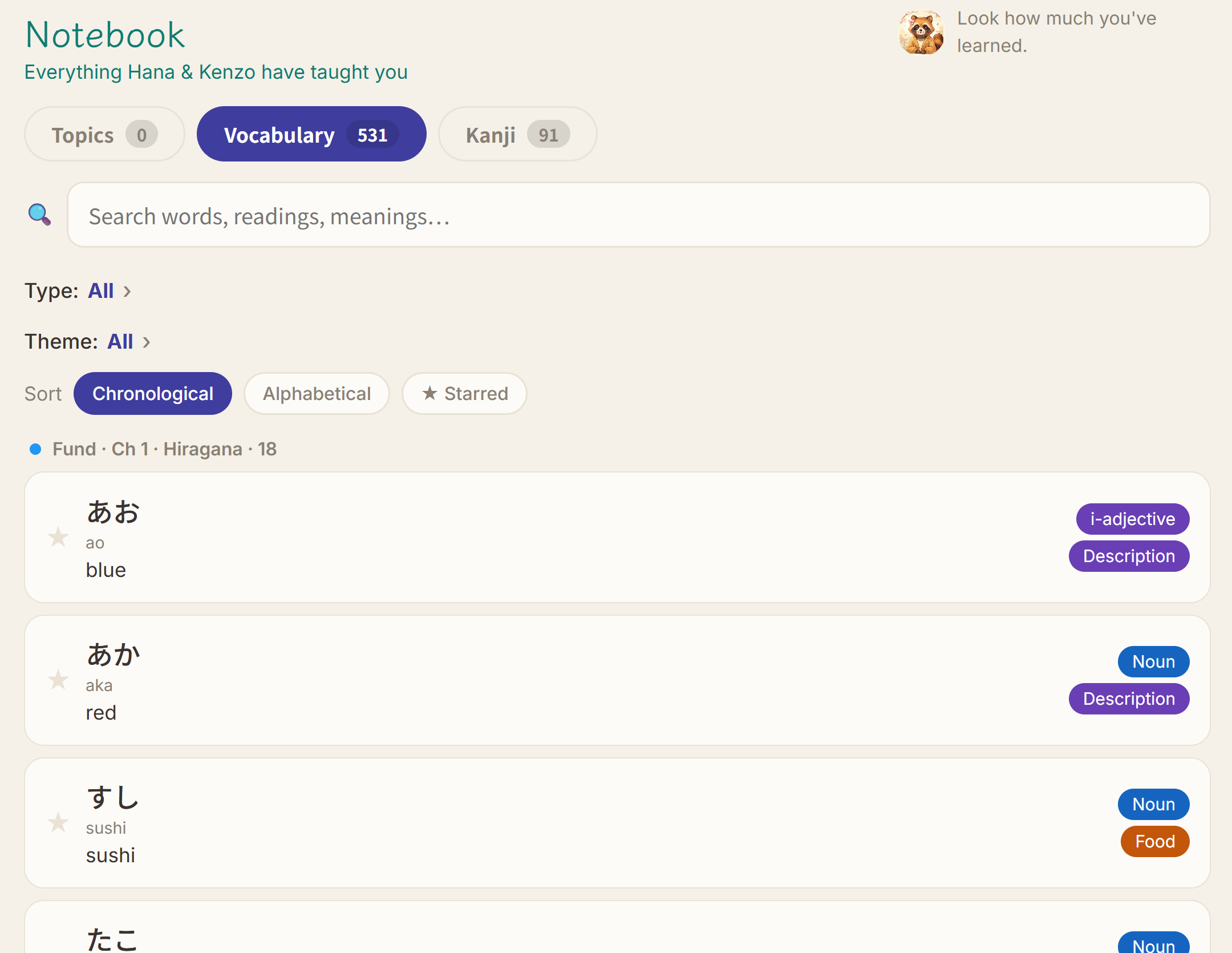
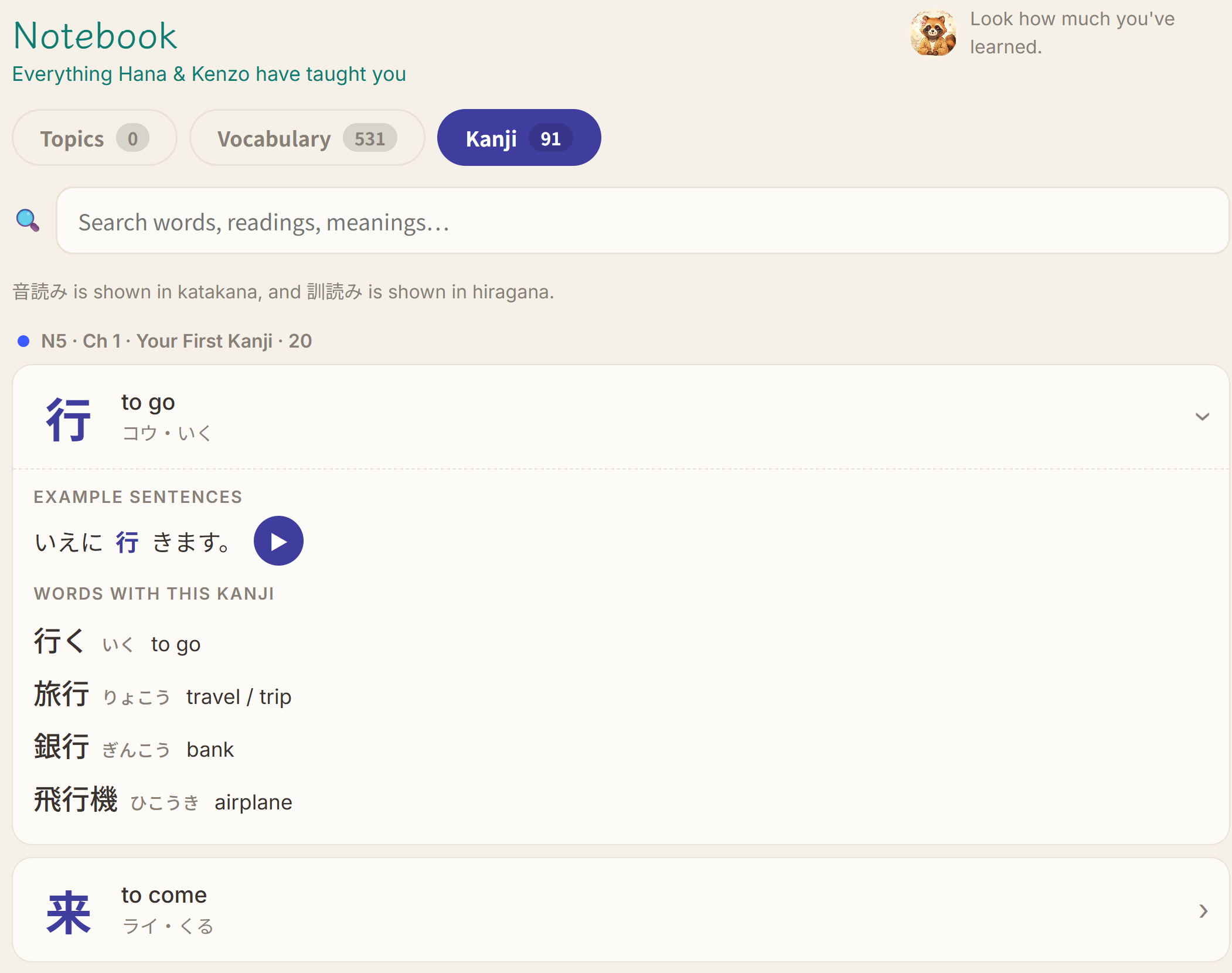
You never take notes. Every word, kanji and grammar point you meet is recorded as you go — searchable, filterable, and grouped by the chapter it came from.
Exams
Each exam path includes full mock papers built to the shape of the real thing — timed, in the same sections, and scored per section so you can see whether it is your reading or your listening that needs the work.
The paths
One ladder from your first kana upward, with dedicated routes for each exam. Paths still being written are marked.
Both kana scripts in full — reading and writing hiragana and katakana, with audio on every sound.
Your first kanji, verbs and their conjugations, particles, adjectives, numbers and time, te-form, nai-form, plans and experiences — then reading and listening practice.
Plain and potential forms, conditionals, giving and receiving, keigo groundwork, longer reading and faster listening.
The upper ladder — the grammar, vocabulary and reading stamina each level asks for, with mock papers throughout.
A dedicated route through the writing system — radicals, components, readings and compounds, drilled the same way as everything else.
The Examination for Japanese University Admission, with the exam's own format and full mock papers.
Business Japanese — workplace register and the BJT format, with mock tests.
The first script, all of it
Every hiragana character, its sound and how it is written, including the voiced and combined forms. Audio on each one, and enough vocabulary to start reading real words rather than isolated letters.
The second script, and where it is used
All of katakana, plus the reason it exists — loanwords, names and emphasis. By the end you can read a menu, a station sign and most of the foreign words you already know.
Putting the kana to work
Your first real Japanese sentences: introducing yourself, saying what something is, and asking a simple question. This is where the two scripts stop being a memory exercise and start being a language.
How kanji work, and the first set
Readings, meanings and the idea of on and kun, taught through characters you will meet constantly. Each one arrives with the words it builds, so it is never a character in isolation.
Verb groups and the polite form
How Japanese verbs divide into groups, and how each one conjugates into the polite ます form — present, past and negative. The backbone that everything later attaches to.
The particles that mark who does what
は, が, を, に, で and the rest: the small words that decide the meaning of a sentence. Taught with the roles colour-coded, so you can see the job each particle is doing.
い and な adjectives
Both adjective families, how they change for past and negative, and how to string them together to describe something properly rather than one word at a time.
Counting, dates and telling the time
Numbers, the counters that go with them, days, months and clock time. The chapter most likely to be useful on your first day in Japan.
The te-form and what it unlocks
The single most useful conjugation in Japanese: asking for things politely, joining actions together, and saying what is happening right now.
Saying what you do not do
The plain negative, how to say something is not allowed and how to ask permission — the other half of everyday conversation.
Wants, intentions and what you have done
Saying what you want, what you plan to do, and what you have tried before. This is where you start talking about yourself rather than describing objects.
Putting it together at N5 speed
Longer passages and faster audio built only from what you have already learned, so the difficulty is the pace rather than new grammar.
The real paper, timed
Full mock papers in the JLPT N5 format — vocabulary, grammar, reading and listening — timed and scored per section, so you can see exactly which part needs the work.
Dropping the polite endings
The dictionary and plain forms, when they are appropriate, and why almost every grammar point above N5 is built on them rather than on ます.
Everything the te-form does
The te-form beyond requests: giving reasons, asking permission, describing states, and chaining clauses the way a native speaker actually does.
Saying what you can do
How to say you are able to do something, how it differs from permission, and the verbs that behave unusually.
If, when and whenever
と, ば, たら and なら — four ways to say "if" that are not interchangeable, taught by the situations that separate them.
あげる, くれる and もらう
The direction-of-favour verbs, which trip up nearly every learner: who is giving what to whom, and why Japanese cares so much about the answer.
The first steps into polite speech
An introduction to honorific and humble language — enough to be appropriate in a shop, an office or a first meeting, without pretending to be fluent in keigo.
Getting the most from it
Twenty minutes a day beats three hours on a Sunday. The spacing schedule assumes you keep coming back, and the streak is there to make that easy rather than to punish you.
Clear your mistake bank before starting a new chapter. New grammar lands better on vocabulary that is already solid.
Play the audio and repeat it. Reading silently teaches you to recognise Japanese; saying it teaches you to produce it.
Romaji is a crutch that gets expensive later. The first three chapters exist to remove it early, and they are free.
When a word feels familiar but will not come, search it. Seeing it in its chapter with its example sentence is usually enough to fix it.
Take a mock paper before you feel ready. The per-section score tells you where to spend your time, which is more useful than a general feeling of being behind.
A Windows desktop app is on the way, for studying with no connection — on a plane, on a train, or anywhere the signal gives up. Your progress syncs back the next time you are online.
Until then, the browser version works everywhere, including on phones.
The explanations, menus and feedback come in twenty languages — Arabic, Burmese, Chinese (Simplified), Chinese (Traditional), English, Filipino, French, German, Hebrew, Hindi, Indonesian, Italian, Korean, Malay, Nepali, Portuguese (Brazil), Russian, Spanish, Thai and Vietnamese. The Japanese itself is never translated — that is the whole point of it.
The more advanced paths go further still. From N4 upward the chapters are taught in Japanese — the explanations as well as the examples — so the later paths are genuine immersion, with the app's own menus and buttons still in whichever language you picked.
The story
You have joined a private immersion program, hosted in a house in the Japanese countryside. You arrive early — early enough to catch your hosts mid-shapeshift.
Kenzo and Hana are tanuki, living as humans and working as Japanese teachers. Kenzo is the Master: he sets the goals and runs the tests. Hana is the Teacher: she guides the learning. You agree to keep their secret, and the program begins.
It is a light frame around serious content. The story is why the app has a voice; the grammar, the drilling and the exams are why it works.
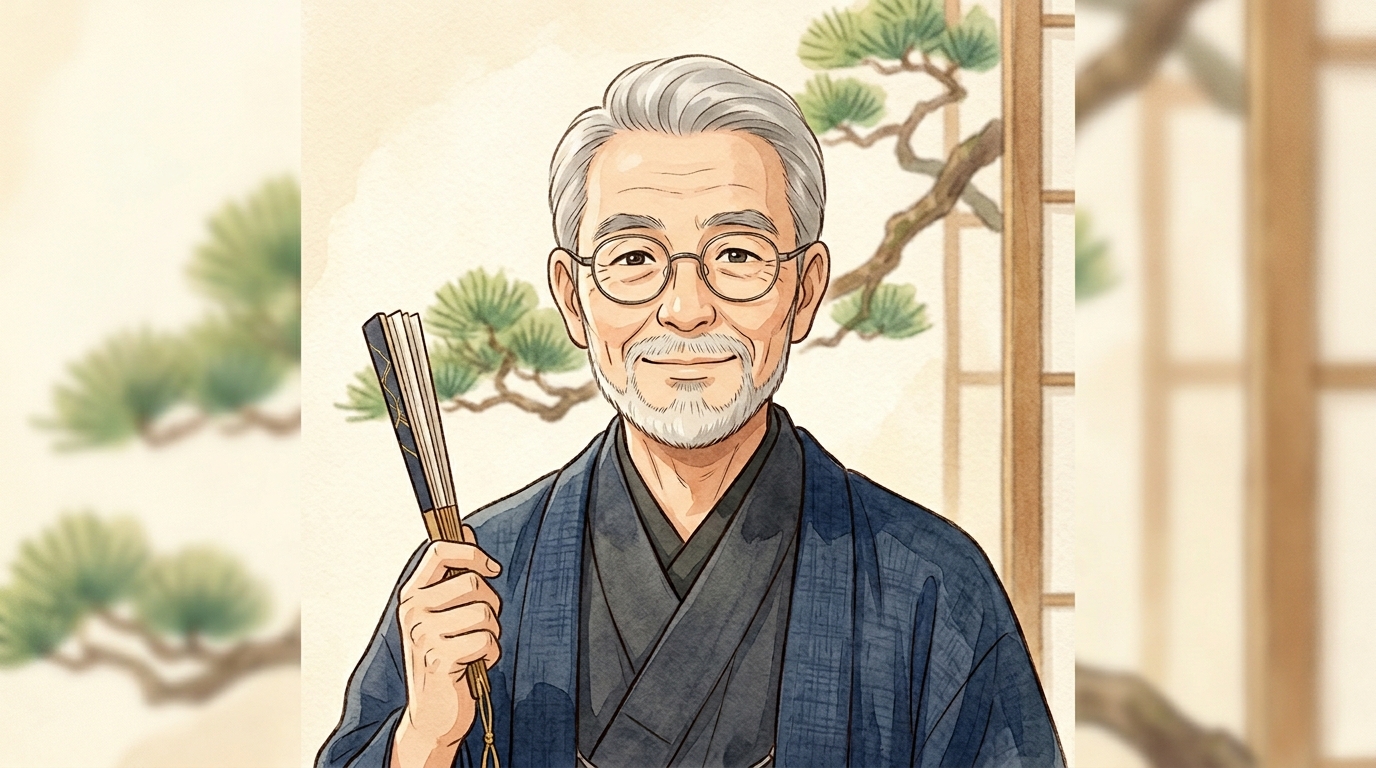
The Master. Sets the goals, runs the tests.

The Teacher. Guides the learning.
Hiragana and katakana in full, free forever. Decide after that.